
Avtor: Yuebo Jiang, Xian Shi and Yan Tang
Abstract
Background: Acupuncture is one of the important parts of therapeutic methods in traditional Chinese medicine, and has been widely used for the treatment of nerve deafness in recent years. The current study was to evaluate the efficacy and safety of acupuncture therapy for nerve deafness compared with conventional medicine therapy. Methods: PubMed, the Chinese National Knowledge Infrastructure Database, the Chinese Science and Technology Periodical Database, the Chinese Biomedical Database, the Wanfang Database were searched for articles published to identify randomized controlled trials evaluating efficacy and side effects between acupuncture and conventional medicine therapies up to 2013/06. Results: A total of 12 studies, including 527 patients assessed the efficacy and safety of acupuncture therapy for nerve deafness. Overall, the efficacy of acupuncture was significantly better than that of the conventional western medication (RR: 1.54, 95% CI: 1.36-1.74) or traditional Chinese medicines (RR: 1.51, 95% CI: 1.24-1.84), and the efficacy of acupuncture in combination with conventional western medication or traditional Chinese medicine was better than that of the conventional western medication alone (RR: 1.51, 95% CI: 1.29-1.77) or traditional Chinese medicine alone (RR: 1.59, 95% CI: 1.30-1.95). Based on the comparison of number of deafness patients who were completely cured, the efficacy of acupuncture in combination with traditional Chinese medicines was better than that of traditional Chinese medicine alone (RR: 4.62, 95% CI: 1.38-15.47). Conclusions: Acupuncture therapy can significantly improve the hearing of patients with nerve deafness, and the efficacy of acupuncture in combination with medication is superior to medication alone.
Keywords: Acupuncture therapy, nerve deafness, TCM therapies, meta-analysis, randomized controlled trials
Introduction
Nerve deafness, also known as sensorineural deafness, refers to hearing impairment resulting from disorders of the internal ear, auditory nerves and auditory center from different causes, even hearing loss [1], and is primarily manifested by unilateral or bilateral ears progressive hearing impairment at different levels even deafness, accompanied with tinnitus, sensation of intra-aural occlusion and the like. With the increasing pressure in mordent life and unhealthy lifestyle, more and more people suffer from serious hearing impairment, and the incidence of nerve deafness is increasingly high, and in teenagers under the age of 18, six people from 1000 people suffer from nerve deafness [2,3]. This disease may cause language barriers and communication barriers as well as serious psychological barriers in patients, has a serious impact on patient’s daily work and life and also brings the society with heavy social and economic burdens.
There are many factors causing nerve deafness, and the pathogenic mechanisms and pathological changes are quite different, so far no simple and effective medication and treatment method has been reported for all disease conditions. At present, the comprehensive treatment method is adopted in the clinic for the treatment of this disease, which focuses on the causes of the diseases and additionally selects vasodilators, drugs for reducing blood viscosity, vitamin B complex, energy formulations and steroid hormones if necessary. However, all these drugs have a certain limitation despite of temporary improvement of symptoms and remission of the disease. The treatment of nerve deafness is still a thorny issue for otologists. Exploring an effective and feasible treatment method has great significance.
Huangdi Neijing (a classic book of traditional Chinese medicine) reports the pathogeny and pathogenesis of ‘deafness’ as well as acupuncture treatment principle and acupoint selection. As an important part of traditional Chinese medicine, acupuncture has been more and more widely used for the treatment of nerve deafness. Many clinical trials have found that acupuncture has a certain effect on improving the hearing in patients with nerve deafness [4-6]. However, no high-level overall review on evaluation of acupuncture treatment of nerve deafness has been searched so far, and there are few research reports on the safety of acupuncture treatment of nerve deafness. Therefore, there is an urgent need for system evaluation on efficacy and safety of acupuncture treatment of nerve deafness, so as to provide a reference for acupuncture treatment of nerve deafness in the clinic.
Methods
Literature search
A search of the literatures was conducted for studies that reported the therapeutic efficacy of acupuncture for nerve deafness. PubMed, the Chinese National Knowledge Infrastructure Database (CNKI), the Chinese Science and Technology Periodical Database (VIP), the Chinese Biomedical Database (CBM), the Wanfang Database were searched to identify RCTs published about acupuncture therapy for nerve deafness up to 2013/06. The key words used in literature searches included the following: “shen_jing_xing_er_long” (nerve deafness), “gan_yin_shen_jing_xing_long” (sensorineural deafness), “zhen_ci” (acupuncture), “er_zhen” (auricular acupuncture), “dian_zhen” (electroacupuncture), “xue_wei” (acupoint), “nerve deafness”, “sensorineural deafness”, “hearing loss”, “acupuncture”, “acupuncture therapy”, “acupuncture point”.
Criteria for inclusion and exclusion
To be considered for this analysis, published articles had to meet the following criteria: (1) Randomized controlled trials, regardless of publication status. The language was limited to Chinese and English; (2) Patients with nerve deafness, regardless of age, sex and ethnic origin; (3) Interventions in the treatment group was acupuncture including ear acupuncture and electro-acupuncture, regardless of the type and acupoint. Interventions in the control group was no treatment, placebo (sham acupuncture), or conventional medicine. In addition, studies of acupuncture plus conventional medicine versus conventional medicine alone were also included. (4) The main outcome was the improvement of hearing. The secondary outcomes were the improvement of tinnitus and dizziness, recurrent rate and number and type of adverse events.
Trials were excluded if any of the following were identified. (1) Studies of duplication; (2) Information of participants, interventions, or outcomes were not available; (3) Studies of acupuncture plus conventional medicine versus another conventional medicine.
Study selection
Search results from different databases were imported into the document management software Note Express 2.8. Repeated and non-relevant studies were rejected by screening the title and abstract. The full text of the remaining studies was downloaded. Studies for inclusion were identified according to the inclusion criteria, and finally a decision was made whether or not to include the study. Study selection was carried on by JYB and SX independently. Any disagreement was resolved by discussion.
Data extraction
A data extraction form was designed using Epidata 3.1 software. JYB and SX extracted the data independently and any disagreement was resolved by discussion. The following data were extracted: citations, study setting, sample size, participants (diagnostic criteria, inclusion criteria, exclusion criteria, age, sex, course of disease), the nature of the interventions, outcome measures, the number and type of adverse events, methodological characteristics (random sequence generation, allocation concealment, blinding, completeness of outcome data, selective outcome reporting, and other potential source of bias).
Quality assessment
Risk of Bias Assessment of included studies. The following items were independently assessed by two authors using the Cochrane risk of bias tool recommended by the Cochrane Reviewers’ Handbook 5.0.2: [7] random sequence generation, allocation concealment, blinding, completeness of outcome data, selective outcome reporting, and other potential source of bias. The risk of bias for each item was graded as low risk, unclear risk, or high risk. Studies that met all the criteria were categorized as low risk of bias, those that met none of the criteria were categorized as high risk of bias, and the others were categorized as unclear risk of bias if insufficient information was available to make a judgment. Any disagreements were submitted to the third party to resolve.
Statistical analysis
In this study, the relative risk (RR) and mean difference (MD) were used as categorical variables and continuous variables, respectively. The results were reported as RR or MD and 95% confidence interval (CI). Heterogeneity was explored using a Chi-square test and P < 0.1 for the presence of heterogeneity. The quantity of heterogeneity was measured using the I2 statistic. The fixed effects model was used to calculate RR or MD and their 95% CI (P > 0.1). However, when the heterogeneity was high (P < 0.1), a random effects was used. Intention-to-treat analysis, sensitivity analysis, subroup analysis and funnel plot analysis were performed where possible.
All calculations for this meta-analysis were performed with RevMan 5.0. For all calculations, a P value of less than 0.1 was considered statistically significant.
[caption id="attachment_3635" align="alignright" width="300"]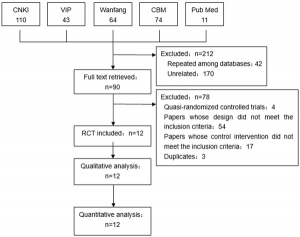 Figure 1: Analysis of the search results.[/caption]
Results
Literature search
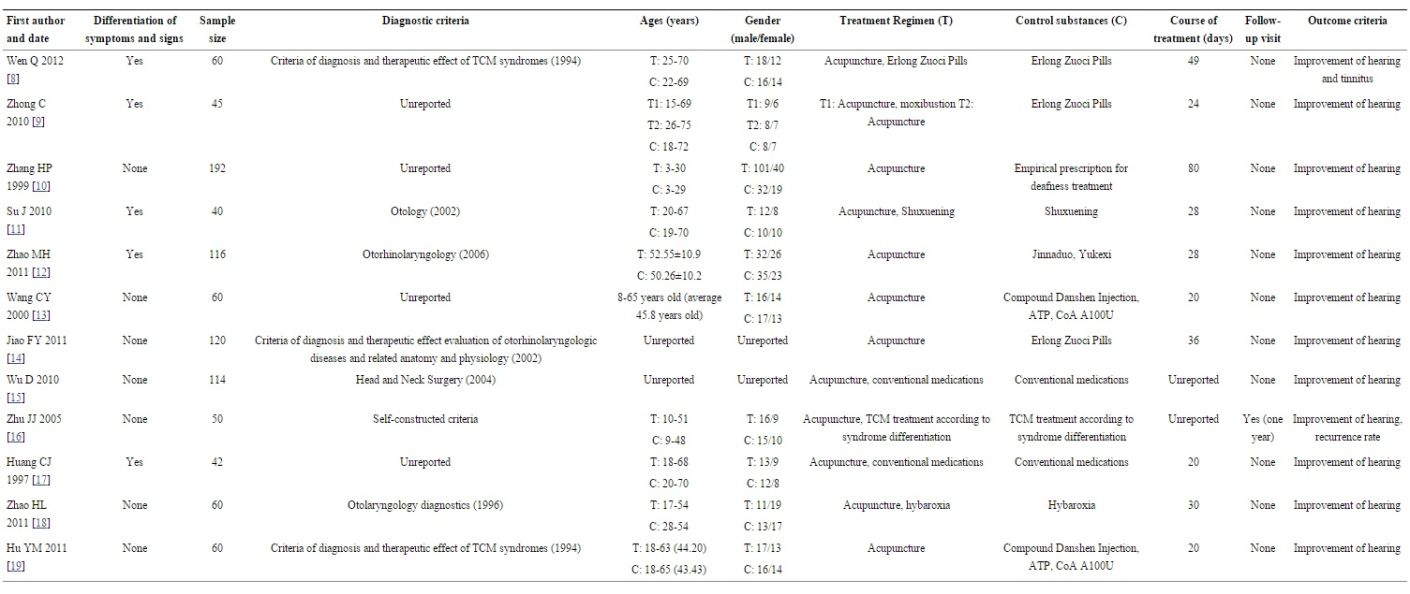
Our initial searches identified 302 references which were then imported into Note Express 2.8 software. 212 studies were excluded due to their repeated report in different databases or obvious irrelevance after reading the title and abstract. After reading the full text of the remaining 90 studies, 12 randomized controlled trials were included in the final review (Figure 1 and Table 1) [8-19].
Table 1: Characteristics of the trials included in the meta-analysis
Acupuncture versus conventional medicine
Four, [10, 12, 13, 19] of twelve trials, assessed acupuncture in comparison with conventional medicine. The fixed effects model was used to analyze for no apparent heterogeneity (P > 0.1, I2 = 0%). The results indicated that compared with conventional medicine, acupuncture demonstrated a statistically significant benefit for hearing improvement (P < 0.00001, RR = 1.54, 95% CI: 1.36-1.74) (Figure 2). Figure 2: Efficacy evaluation of acupuncture treatment for nerve deafness RR
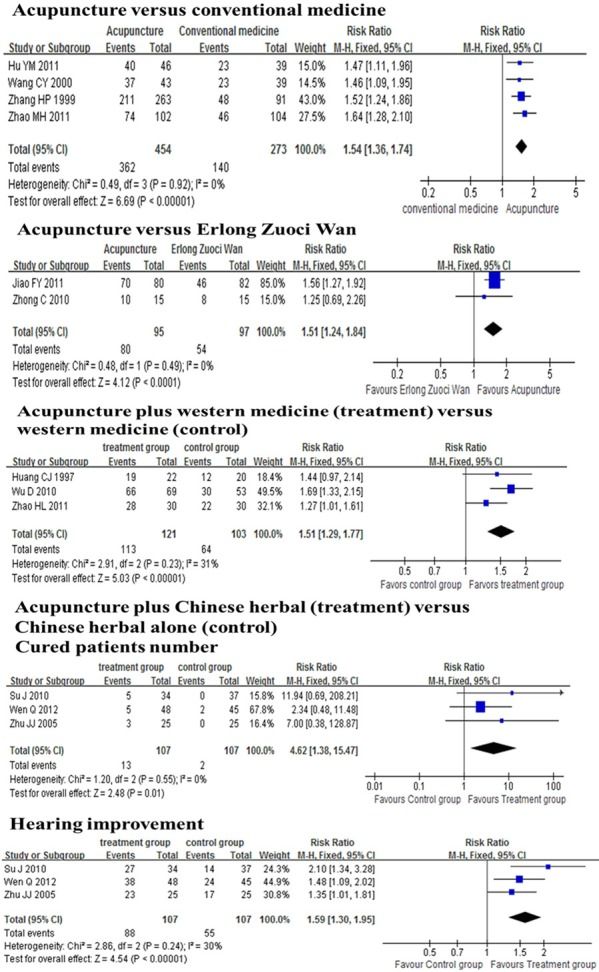
Efficacy evaluation of acupuncture treatment for nerve deafness RR, risk radio; CI, confidence interval; inconsistency among results: I2 test for overall effect; Z statistic with P-value.
Acupuncture versus Chinese herbal medicine
Two studies tested acupuncture in comparison with Erlong Zuoci Wan [9, 14]. Meta-analysis showed that compared with Erlong Zuoci Wan, acupuncture demonstrated a statistically significant benefit for hearing improvement (RR = 1.51, 95% CI: 1.24-1.84, P < 0.0001) (Figure 2). Acupuncture plus conventional western medicine versus conventional western medicine Three studies reported hearing improvement after acupuncture plus conventional western medicine compared with western medicine alone [15, 17, 18]. There was no apparent heterogeneity (P = 0.23, I2 = 31%). A fixed effects model was used to combine effects. Our results showed that acupuncture plus conventional western medicine therapy was more effective than western medicine alone in hearing improvement (RR = 1.51, 95% CI: 1.29-1.77, P < 0.00001) (Figure 2).
Acupuncture plus Chinese herbal versus Chinese herbal alone
Three trials assessed hearing improvement between acupuncture plus Chinese herbal and Chinese herbal alone [8, 11, 16]. There was no apparent heterogeneity in cured patients number (P = 0.55, I2 = 0%) and hearing improved number (P = 0.24, I2 = 30%). Our results showed that acupuncture plus Chinese herbal was superior to Chinese herbal alone therapy in cured patients number (RR = 4.62, 95% CI: 1.38-15.47, P = 0.01) and hearing improveent number (RR = 1.59, 95% CI: 1.30-1.95, P < 0.00001) (Figure 2).
Side effects
None of the studies included reported the number and type of adverse events. Therefore, we were unable to assess the safety of acupuncture.
Funnel plot analysis
Although 12 studies in-cluded in this review were all included in the Meta-analysis, the number of studies included in each meta-analysis was less [2-4]. Therefore, the potential publication bias in this review could not be analyzed.
Discussion
Based on the above meta-analysis result, acupuncture can significantly improve the hearing of patients with nerve deafness compared to traditional Chinese medicines and western medicines, and the efficacy of acupuncture in combination with medication is better than that of medication alone. However, this result may lead to overvaluation of acupuncture efficacy because of small sample size of included papers, poor methodology quality and other factors. In addition, since no safety-related outcomes are reported in all the twelve included papers, the evaluation on safety of acupuncture can’t be performed.
Firstly, the quality of papers included in this study is not high, resulting in evaluation bias. The result of methodology quality assessment shows that all the papers included are at a high bias risk or unknown bias risk. As the vast majority of studies do not report either the method for randomization or any information about blinded method, the patients or investigators may make a subjective judgment on efficacy of intervention measures, resulting in the bias of test outcomes. There is no information about losing, withdrawal and lost follow-up of subjects in all the studies, which may cause overvaluation of acupuncture efficacy. The quantity of papers included in meta-analysis is too small to make funnel plot analysis. But, all the papers included report that the efficacy of intervention measures (acupuncture treatment) in the test group is better than that of the control group, indicating a publication bias in this study. Besides, all the papers included are written by Chinese authors, indicating a selection bias in this study.
Also, the placebo control used in RCT may eliminate the effect of disease progression, can directly detect the difference between an investigated drug and a placebo under test conditions, and is commonly used to verify which treatment regimen is truly effective [20]. No one of the twelve RCT papers included in this study adopts the placebo control, the reason for it is that many clinical investigators in traditional Chinese medicine believe that the placebo control does not conform to the ethical requirements, and placebo for acupuncture in clinical trials is hard to be selected and implemented.
Furthermore, all the papers included report the outcome of improved hearing, in which the hearing improvement is classified into four grades: complete recovery, marked effectiveness, effectiveness and ineffectiveness, even a part of the papers adopt the complex outcome indicators, which may lead to the limitation of outcomes because the four grades of classification do not conform to the international standards and bring the difficulty in explanation of the efficacy.
As the vast majority of clinical trials of acupuncture treatment of nerve deafness have small sample size and bias as well, it is desired that large-sample high-quality clinical trials are conducted in future to verify the efficacy of acupuncture treatment of nerve deafness. Randomized and blinded methods should be fully described in the clinical trials. It is difficult to blind the patients receiving acupuncture treatment, but the blinding of the outcome analysts and statistical analysts may reduce the performance bias and measurement bias to a certain extent. The test indicators should be selected in accordance with the international standards, the clinically relevant outcomes (such as life quality) should be used whenever possible, and beside the efficacy, the safety of acupuncture treatment should be evaluated. In addition, the study report should follow the Revised Standard for Reporting Interventions in Clinical Trials of Acupuncture (SIRICTA) [21], which clearly describes the details and treatment process of acupuncture to help other investigators in clinical general practice.
In summary, the result of meta-analysis shows that acupuncture may effectively improve the hearing conditions of patients with nerve deafness, but we should be careful to make an explanation on the result of meta-analysis because of the defects due to system error, random error and clinical trial methodological quality, and we have no enough evidence to evaluate the safety of acupuncture treatment.
Disclosure of conflict of interest
None.
References
- Lang SC, Gu R, Wang ZM. Otology. Shanghai: Shanghai Scientific and Technological Literature Publishing House Co, Ltd.; 2002. p. 836.
- Huang BY, Zdanski C, Castillo M. Pediatric sensorineural hearing Loss, Part 1: practical aspects for neuroradiologists. AJNR Am J Neuroradiol. 2012;33:211–7.
- Huang BY, Zdanski C, Castillo M. Pediatric sensorineural hearing Loss, Part 2: syndromic and acquired causes. AJNR Am J Neuroradiol. 2012;33:399–406.
- Wu D, Gao WB. Clinical study of electro-nape-acupuncture and acupunture at acupoints around ear in treatment of sudden sensorineural deafness. JCAM. 2010;26:30–32.
- Wang Y, Gao WB. Efficacy of Electro-Nape-Acupuncture in Treatment of Sudden Deafness. JCAM.2006;22:33–34.
- Li ZP, Wu B, Zhang HL. Treatment of sensorineural deafness by acupunture at baihui and dazhui acupoints, 110 cases. Liaoning Zhong Yi Za Zhi. 2008;35:921–922.
- Higgins Jpt, Green S. The Cochrane collaboration, Cochrane handbook for systematic reviews of interventions. Version 5.0.2. 2009. (http://www.cochrane-handbook.org)
- Wen Q, Zhao J. Efficiency Of Acupunture in combination of medication in treatment of tinnitus and deafness with syndrome of kidney-essence deficiency. JCAM. 2012;28:17–19.
- Zhong C, Gao ZX. Efficiency of acupunture in treatment of primary nerve deafness. Shanghai Zhen Jiu Za Zhi. 2010;29:397–398.
- Zhang HP, Zhang JG, Xue XL. Acupunture treatment of 141 cases with nerve deafness caused by drug poisoning. Zhongguo Ye Jin Gong Ye Ke Xue Za Zhi. 1999;16:240–241.
- Su J, Yu XP. Acupunture Treatment of Sensorineural Deafness. JCAM. 2010;26:40–41.
- Zhao MH, Feng YJ, Fu LX, Qiao FY, Zhu HX. Randomized controlled study of acupunture treatment of sensorineural deafness. JCAM. 2011;27:5–8.
- Wang CY, Gan L, Hu YM. Clinical trials of acupunture treatment of nerve deafness. Zhongguo Zhen Jiu Xue. 2000;10:205–208.
- Qiao FY, Ge YF. Acupunture Treatment of 60 cases of Sensorineural Deafness with Syndrome of Kidney-Essence Deficiency. Chin J Ophthalmol and Otorhinolaryngol. 2011;1:45–46.
- Wu D, Gao WB. Clinical study of electro-nape-acupuncture and acupunture at acupoints around ear in treatment of sudden sensorineural deafness. JCAM. 2010;26:30–32.
- Zhu JJ. Electro-Acupuncture treatment in combination with traditional Chinese medicines of 25 cases of nerve deafness. Sichuan Zhong Yin Za Zhi. 2005;23:90–91.
- Huang CJ. Efficacy of acupuncture treatment of nervous tinnitus and deafness. Yunnan Zhong Yi Za Zhi. 1997;18:33–34.
- Zhao HL, Lu JB. Efficacy of acupuncture in combination with Hyperbaric oxygentherapy of nervous deafness. Xifang Chuan Tong Zhong Yi Za Zhi. 2011;24:86–88.
- Hu YM. Efficacy of Electroacupuncture Treatment of Nerve Deafness, PhD thesis of Heilongjiang University Of Chinese Medicine. 2011.
- Wang JL. Clinical Epidemiology-clinical Research Design, Measurement and Evaluation. Shanghai: Shanghai Scientific and Technological Literature Publishing House Co., Ltd.; 2001. p. 55.
- MacPherson H, Altman DG, Hammerschlag R, Youping L, Taixiang W, White A, Moher D. STRICTA Revision Group. Revised standard for reporting interventions in clinical trials of acupuncture (STRICTA): Extending the CONSORT statement. J Evid Based Med. 2010;3:140–145.